
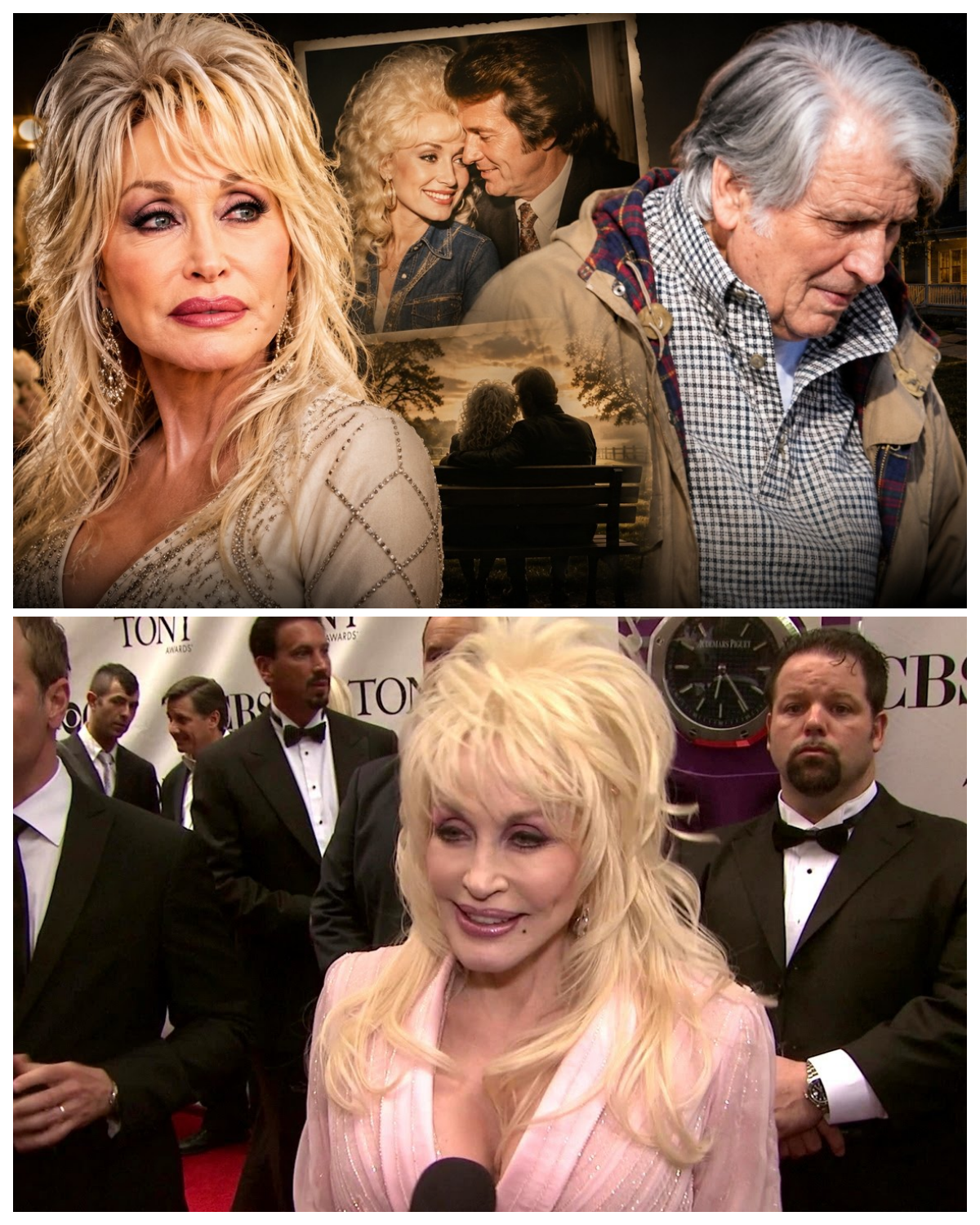
They asked it in interviews.
They asked it in tabloid columns.
They asked it on television stages and in backstage whispers and in the kind of conversations that happen when someone has been married to the most famous woman in country music for longer than most people have been alive.
And nobody has ever actually seen him.
Where is Carl Dean?
Dolly Parton sold out arenas in 30 countries.
She wrote over 3,000 songs.
She built a theme park that bears her name.
She became a cultural monument, a national treasure, a woman so universally beloved that when she was offered a presidential medal, she turned it down because she felt she didn’t deserve it and the country loved her even more for it.
She has been pH๏τographed 10 million times.
She has been interviewed 10 million times more.
There is almost nothing about Dolly Parton that the world does not know.
And yet for nearly six decades, she was married to a man that most people had never seen.
Not a mysterious man, not a dangerous man, not a man with secrets or scandals or anything to hide, just a man who ran an asphalt paving company in Nashville, Tennessee.
A man who went to work, who came home, who loved his wife with complete and quiet consistency for 59 years.
A man who, as the joke circulated for decades, people had begun to suspect Dolly had simply made up.
She hadn’t.
Carl Thomas Dean was real.
More real perhaps than anyone else in Dolly Parton’s extraordinary life because he was the only person in that life who never once tried to be part of the story.
He was the only person who loved Dolly Parton, the woman, completely apart from Dolly Parton, the legend.
And that that precise, deliberate, almost radical act of private love is what this story is about.
If the quiet men who hold the great ones steady have ever moved you, the ones who never wanted the spotlight but never left the side of the ones who did, leave a tribute below for Carl Dean, the man who anchored a legend and stayed invisible by choice.
Because what follows is not a story about fame.
It is a story about what makes fame survivable.
And it begins the way so many impossible love stories begin on an ordinary street corner.
On the very first day, a girl from the mountains arrived in a city that was about to change her life forever.
She arrived on a Tuesday.
Dolly Rebecca Parton had graduated from Sevier County High School the day before, Friday the 5th of June, 1964.
And by the time the weekend was over, she had packed everything she owned into a single bag and boarded a bus to Nashville.
She was 18 years old.
She had been dreaming of this city since she was a child, singing on the porch of a one- room cabin in the Smoky Mountains with no electricity and no running water and 11 brothers and sisters sleeping in the same small space.
Nashville was the dream.
Nashville was the only plan she had ever made.
And on the very first day she arrived before she had found a place to stay, before she had walked into a single recording studio, before Nashville had offered her a single thing.
She met Carl Dean.
The location was not romantic in any conventional sense.
It was a coin operated laundromat on Dolly’s first full day in the city.
She was standing outside.
She was 18.
She was wearing, by her own description, the kind of outfit that turned heads because Dolly Parton had always understood exactly what she looked like and had never once pretended otherwise.
She was there.
He drove past and then he stopped.
Carl Thomas Dean was 22 years old.
He had been born on the 22nd of July 1942 right there in Nashville, Tennessee, the city he would never really leave for the rest of his life.
He was not in the music business.
He had no ambitions in the music business.
He was a young man from Nashville who worked with his hands and who on that particular morning happened to drive down the particular street where a girl from the mountains was standing outside a laundromat on her first day in the city that was going to make her famous.
He stopped the car.
He
Talked to her.
And Dolly Parton, who would later write thousands of songs about love, who had an instinct for human nature so precise it bordered on supernatural, who could read a room and read a heart and read a lyric with equal and devastating accuracy.
Dolly Parton went home that same day and told her aunt with complete certainty, “I met this man and I’m going to marry him.”
She was 18 years old.
She had been in Nashville for exactly one day.
She was right.
What happened in the two years between that laundromat and a wedding ceremony is a quieter story than most people expect from Dolly Parton.
But it is exactly the kind of story that explains everything that came after.
Carl Dean did not pursue Dolly into the recording studios.
He did not follow her up the ladder of early Nashville ambition.
He did not insert himself into the world she was building or try to become part of the machinery that would eventually make her one of the most successful entertainers in American history.
He dated her in the straightforward, uncomplicated Tennessee way.
He took her to dinner and he drove her home and he was there when she needed him and he gave her space when she needed that.
He was from the very beginning consтιтutionally incapable of performing for anyone.
The camera, the crowd, the industry, the fame that was already beginning to gather around this extraordinary young woman.
None of it interested Carl Dean in any meaningful way.
He was drawn to Dolly the person.
The rest of it was noise.
They married on the 30th of May, 1966.
The ceremony was held in Ringold, Georgia, not Nashville.
The choice was deliberate.
Dolly was already well enough known in Nashville’s music circles that a wedding there risked becoming a press event, a public spectacle, exactly the kind of attention that Carl Dean had already made clear he had no interest in.
Ringold was small and quiet and far enough from the industry that they could say their vows in peace.
The guest list was almost no one.
Just their closest family, no pH๏τographers, no industry figures, no spectacle, just a man and a woman and a promise made in a small town in Georgia because the woman understood even then that the man she was marrying would only be truly himself away from the noise.
And she loved him enough to give him that right from the beginning.
Carl Dean returned to Nashville after the wedding and went back to work.
He built his business, Dean Asphalt and Paving from the ground up with his hands in the concrete and unglamorous world of road construction and commercial paving in Tennessee.
It was not a glamorous business.
It was not a famous business.
It was a real business, the kind that requires physical labor and logistical precision.
And the willingness to show up every single day in conditions that have nothing to do with spotlights or applause.
He was good at it.
And while Dolly Parton climbed, while she recorded and toured and wrote hit after hit, while Nashville opened its arms to her, and then the whole country did, while her name grew into something that would eventually transcend country music entirely, Carl Dean stayed in Nashville
And paved roads.
He was not left behind.
He was not neglected.
He was not the sad man waiting at home while his wife conquered the world.
He was by every account and by his own evident contentment exactly where he wanted to be.
That is the part of the story that most people find hardest to believe.
Because the story we tell about marriages like this, the famous woman, the invisible husband is usually a story about sacrifice, about the man who gave up his ambitions for hers, about quiet suffering behind closed doors.
But Carl
Dean had no ambitions that Nashville’s spotlight could have served.
He wanted to build things.
He wanted to go home.
He wanted his wife.
He wanted Tennessee.
He had all of it.
And every night when Dolly Parton came home from being Dolly Parton, from being the rhinestones and the wigs and the 30,000 songs and the television specials and the soldout arenas, she came home to a man who was, as she would say decades later, the only person I know who doesn’t walk around thinking he’s married to Dolly Parton.
He knew exactly who he had married.
He just didn’t think it was the most important thing about her.
There is a question that follows every long marriage.
Not the question people ask at anniversary parties with champagne glᴀsses raised and speeches about love and commitment and the beautiful mystery of two people choosing each other again and again across the decades.
That question is easy.
That question is performative.
The real question, the one that sits underneath all of it, quiet and uncomfortable, is this.
How did you actually do it?
Not the romance, not the grand gestures, the actual daily architecture of a marriage that lasts.
The invisible structure that holds two people together, not for 5 years or 10 years or even 20, but for 59.
Through fame and obscurity and money and distance and the particular grinding pressure of one person being among the most recognized human beings on the planet while the other person simply wanted to go to work and come home and be left alone.
How did they do it?
Dolly Parton answered that question more times than she could count.
And every time she answered it, she said the same thing in different words with different examples, in different decades and different interview rooms and different stages of the extraordinary life she was living.
But the answer was always the same.
We don’t smother each other.
That was the formula.
Four words.
Deceptively simple.
Almost anticlimactic given the 60 years of legend it produced.
But beneath those four words was an entire philosophy of marriage.
A set of principles that Carl Dean and Dolly Parton had arrived at intuitively and together almost from the very beginning.
A philosophy built not on proximity but on respect, not on possession but on idenтιтy.
Not on the need to be everything to each other, but on the rarer and more demanding commitment to let each other be entirely themselves.
The first principle was space, radical, unconditional, structurally builtin space.
Dolly traveled.
She toured.
She spent months at a time away from Nashville, away from the house, away from the man who stayed behind and ran his business and waited.
Not with resentment, not with longing that curdled into bitterness, but with the kind of patient, grounded love that does not require constant presence to remain intact.
She was gone for weeks, sometimes longer, and when she came back, Carl Dean was there.
He was always there.
She talked about this openly in the precise and unguarded way that Dolly Parton talked about everything that mattered to her.
She said, “The good thing about Carl is that he’s not in show business and doesn’t want to be.
If he were, I’d probably have left him.
It sounds like a joke.”
It has the rhythm of one of her jokes, the kind she delivered with perfect timing and a smile that contained mulтιтudes, but it was not a joke.
It was the most honest thing she could have said because the marriage worked precisely because Carl Dean existed in an entirely separate world from the one that consumed her professional life.
He was not a colleague.
He was not a collaborator.
He was not someone whose ego was entangled with hers, whose success was measured against hers, whose idenтιтy was threatened or diminished or complicated by the scale of what she was becoming.
He was her husband.
That was the whole of it.
And that wholeness, that clean, uncomplicated definition of what Carl Dean was in Dolly Parton’s life was the foundation that everything else was built on.
The second principle was idenтιтy, specifically the protection of it.
On both sides, Dolly Parton understood with the clarity of someone who had spent her entire adult life being perceived and projected onto and turned into a symbol that the most dangerous thing a famous person can do to the person they love is to absorb them, to make them an extension of the public persona, to turn a private human being into a supporting character in someone else’s story.
She never did that to Carl.
She talked about him.
She mentioned him in interviews, referenced him in songs, described him in the warm and sometimes comic terms that made the world fall in love with the idea of him even without ever seeing him.
But she never brought him into the light without his permission.
She never used him as a prop.
She never made him perform the role of Dolly Parton’s husband for a public that would have consumed that performance greedily and left nothing of the real man behind.
Carl, for his part, protected her idenтιтy, too, in the way that only someone with no stake in the fame could.
He knew the difference between Dolly Parton, the icon, and Dolly, the woman who came home at the end of the night.
He held that line without effort because for him there was no line to hold.
He was simply not interested in the public version of his wife.
He was interested in her.
She described it with the kind of precision that only comes from having thought about something for a very long time.
She said, “He’s the only person I know who doesn’t walk around thinking he’s married to Dolly Parton.
” And then when asked whether Carl was ever jealous of the men she worked with, the co-stars, the collaborators, the parade of male artists whose names appeared alongside hers across five decades of American music, she said something even more telling.
She said, “He says, I married Dolly, not you.
He knows the difference.
” That sentence is worth sitting with for a moment because what Carl Dean understood, what he had perhaps always understood from that very first conversation outside a laundromat on a June morning in 1964 was that the woman on the stage and the woman who came home were the same woman, not two separate people, not a public mask and a private face, the same woman fully.
And his love was for that wholeness, not for the performance of it.
He was not intimidated by Dolly Parton.
He was not diminished by her.
He was not threatened by the scale of what she was because his sense of himself had nothing to do with her fame.
He had his own work, his own purpose, his own idenтιтy built with his hands in asphalt and concrete in the unglamorous and entirely satisfying world of a man who knew exactly who he was.
That security, his security, was the third and perhaps most essential principle of all.
Because what breaks marriages like theirs, marriages between the extraordinarily famous and the deeply private is almost never infidelity or incompatibility in the conventional sense.
What breaks them is the slow erosion of the private person.
The way that fame over time presses on everything around it.
The way it demands not just the famous person’s idenтιтy, but the idenтιтies of everyone connected to them.
The way it turns husbands into footnotes and private lives into backstory and real love into content.
Carl Dean never became content.
He remained for 59 years stubbornly and completely himself.
A Nashville man, a business owner, a husband who drove his wife to the airport and picked her up when she came back and sat on the porch with her and talked about nothing important and everything that mattered.
A man who loved Tennessee the way some people love a religion with the kind of loyalty that doesn’t require justification or explanation.
Dolly understood that this was not a limitation.
It was not the small life of a man who couldn’t keep up with her.
It was the deliberate, sovereign choice of a man who knew precisely what he wanted and had built it carefully and without apology over the course of a lifetime.
And she loved him for it.
Loved him specifically for it, for the immovability of him, the groundedness of him, the way he remained exactly Carl Dean through every season of her extraordinary becoming.
The formula seems to work for us, she said late in their life together.
We don’t smother each other.
Simple, true, harder than it sounds.
And held without breaking for 59 years.
Here is what 60 years of deliberate invisibility actually looks like.
Not hiding, not absence, not a man who is ashamed of his wife or indifferent to her success or quietly miserable behind the closed doors of a life lived in the shadow of someone else’s fame.
None of that.
Carl Dean’s invisibility was not the invisibility of a man who had been left out.
It was the invisibility of a man who had opted out consciously, consistently, and with complete peace from a world that would have consumed him if he had let it.
The distinction matters enormously because the story that fame tells about the people who refuse, it is almost always a story about failure.
About the ones who couldn’t keep up, about the men and women who stood at the edge of the spotlight and flinched.
The industry has no language for the person who looks directly at everything the spotlight offers.
The recognition, the access, the validation, the sheer intoxicating power of being seen by millions and says with complete sincerity and zero regret, “No thank you.
I have somewhere else to be.
Carl Dean said that for 59 years.
And the world, which had spent those same 59 years being charmed and dazzled and undone by the woman he came home to every night, had almost no idea what he looked like.
The joke ran for decades.
In interviews, in profiles, in the kind of long- form magazine pieces that attempted to explain the phenomenon of Dolly Parton to readers who already knew everything about her.
The question of Carl Dean was a reliable setpiece.
Journalists asked about him.
Television hosts asked about him.
Audiences at her concerts asked about him.
And Dolly, who had an instinct for deflection as precise as her instinct for melody, handled every question with the same combination of warmth and impenetrability that had protected him since the beginning.
She described him.
She quoted him.
She told stories about him, funny ones, tender ones, stories that made the world feel as though they almost knew him without ever actually seeing him.
She gave the public just enough Carl Dean to satisfy the curiosity without ever giving them the real man.
And the real man, meanwhile, was in Nashville paving roads.
The joke that eventually emerged, and it circulated widely enough that Dolly herself acknowledged it in interviews, was that Carl Dean did not actually exist.
That he was a fiction, a convenient invention deployed by a woman who had spent her entire adult life being pursued by the adoration of the world, and who had simply decided that the most efficient way to manage that adoration was to claim she was already taken by a man no one could verify because no one had ever seen him.
Dolly laughed about it.
She said, “People used to say that I made him up just to keep the men away from me.”
She said it the way she said everything uncomfortable with a smile that acknowledged the absurdity without conceding a single inch of the private life behind it.
The joke was allowed to exist.
The real Carl Dean was not.
In almost 60 years of marriage to one of the most pH๏τographed women in the history of American entertainment, Carl Thomas Dean made exactly two significant public appearances at his wife’s side.
Two, not two dozen.
Not two per decade.
Two total.
In nearly six decades of marriage to a woman who lived her entire professional life in front of cameras, Carl Dean chose to step into that light on precisely two occasions.
And both of them were moments so significant in Dolly’s career that even Carl with all his sovereign disinterest in the public world understood that these were the moments a husband shows up.
The first was in 2015.
The Academy of Motion Picture Arts and Sciences, the organization that awards the Oscars, held its annual Governor’s Awards ceremony, a separate event from the main broadcast designed to honor extraordinary contributions to cinema and the broader cultural landscape.
That year, Dolly Parton was among the recipients.
Recognized for her humanitarian work, decades of philanthropy, tens of millions of dollars donated, the imagination library program that had by that point put books into the hands of millions of children across multiple countries.
Carl came.
He walked the red carpet beside her.
He stood in the light that he had avoided for more than 50 years.
He wore a suit.
He smiled.
The smile of a man who is doing something for someone he loves and is perfectly aware that this is not his natural habitat and is completely at peace with that knowledge.
And Dolly in the interview she gave afterward characteristically perfectly with the exact combination of affection and comedy that defined everything she said about her husband revealed what Carl Dean had spent his time doing on that particular red
Carpet.
He was looking at the other women.
She said it without a trace of jealousy.
She said he was checking out the ladies at the Oscars.
That’s fine with me.
Because of course it was.
Because Dolly Parton had spent 50 years understanding exactly who she had married.
A man with eyes and opinions and a genuine appreciation for beauty in all its forms.
A man who had never pretended to be something other than what he was, and whose complete honesty was one of the reasons she had loved him for half a century.
He came.
He looked around.
He went home.
That was Carl Dean’s first public appearance.
The second came seven years later.
In 2022, Dolly Parton was inducted into the Rock and Roll Hall of Fame.
An honor she had initially declined with characteristic graciousness because she felt that her music was country and not rock and roll, and she did not want to take a place that rightfully belonged to someone else.
The hall overruled her objection.
The public response to her attempt to decline was so overwhelmingly affectionate, because of course it was, because this was Dolly Parton trying to give back an award out of humility, and the world simply refused to let her accepted.
Carl came again.
He appeared beside her at the ceremony.
Older now, in his late 70s, but recognizably the same man who had stopped his car on a Nashville street in 1964 because a girl was standing outside a laundromat, and something about her had made it impossible to keep driving.
He stood in the light a second time.
He endured the cameras a second time.
He was by every visible measure visibly uncomfortable in the way that a profoundly private man is always visibly uncomfortable when the world’s attention is pointed directly at him.
And then he went home, back to Nashville, back to Tennessee, back to the life that had sustained him and sustained their marriage and sustained in ways that the public would never fully understand.
The woman who was standing on that stage accepting the honor.
There is something worth noting about those two appearances.
Beyond the rarity of them, beyond the sheer mathematical improbability of a man spending nearly six decades beside one of America’s most famous women and stepping into the public eye exactly twice.
What is worth noting is why he came.
He did not come to the album releases.
He did not come to the concert tours or the television specials or the film premiieres or the Grammy ceremonies or the country music ᴀssociation awards or the hundreds of other nights when Dolly Parton stood on a stage and received the world’s applause.
He did not come to the industry events or the charity gallas or the press junkets or any of the other machinery of a career as vast and sustained as hers.
He came to the governor’s awards.
He came to the Rock and Roll Hall of Fame.
He came, in other words, to the moments that were not about the music or the performance or the business of being Dolly Parton, but to the moments when the world was trying to say something larger.
When the recognition was not for a song or a show, but for a life, for what she had built, for what she had given, for the full extraordinary weight of everything she had become.
Those were the moments Carl Dean decided were worth showing up for.
That tells you something about him.
Something precise and important and entirely consistent with everything else that is known about the man who spent 59 years being married to the most public woman in country music while remaining himself almost entirely unknown.
He was paying attention the whole time.
He just didn’t need anyone to see him doing it.
And yet, for all the privacy, for all the deliberate distance from the world that wanted so badly to see him, there was one more thing that the decades could not keep entirely quiet.
The love itself, not performed, not publicized, not packaged for consumption by the audience that would have consumed it eagerly if given the chance.
Just the love real and specific and particular to these two people leaking through the edges of interviews and song lyrics and the way Dolly Parton talked about her husband when she forgot for a moment to be guarded.
He will always be the star of my life story.
She said not the most famous person in it.
Not the most decorated or the most celebrated or the most written about the star, the central figure around whom everything else orbited.
She said it about a man who paved roads and she meant every word.
Which brings us to the question that sits at the heart of everything that followed.
What happens to a love like that when one half of it is suddenly, irreversibly gone?
Carl Thomas Dean died on the 3rd of March, 2025.
He was 82 years old.
He died in Nashville, the city where he had been born.
The city where he had lived his entire life, the city he had never really needed to leave because everything he wanted had always been right there.
He died in the place that had made him, surrounded by the life he had built with his hands and his patience, and his complete, unshakable conviction that a quiet life lived well on your own terms was not a lesser life.
It was just a different one.
The announcement came without spectacle because of course it did because spectacle had never been any part of Carl Dean’s story and it was not going to become part of it at the end.
There was no press conference.
There was no carefully managed media statement released through a publicist with a list of approved quotes and a schedule of coordinated coverage.
There was a statement from Dolly.
Simple, direct, written in the voice of a woman who had spent 60 years finding the exact right words for everything and who in this moment set aside the craft entirely and simply said what was true.
She wrote, “Carl and I spent many wonderful years together.
Words can’t do justice to the love we shared for over 60 years.
That was it.
No performance, no elaboration, no reaching for the kind of language that would satisfy the world’s appeтιтe for grief made beautiful and public and consumable.
Just the plain unbearable truth of it, that some loves are too large and too specific and too real to be adequately described by the person living inside them.
Words can’t do justice.
From a woman who had made her life from words.
Who had written over 3,000 songs, who had found language for heartbreak and longing and joy and faith and the particular ache of leaving the mountains you grew up in and the particular wonder of the life that waited on the other side from that woman.
The admission that this was beyond language.
That tells you everything about what Carl Dean was to her.
The grief was private the way everything about Carl had always been private.
Dolly did not make a public spectacle of it.
She did not turn the loss into content.
Did not invite the cameras into the morning.
Did not perform the widowhood for an audience that would have watched with genuine sympathy and genuine hunger in equal measure.
She grieved the way Carl had lived quietly on her own terms in the space between what the world saw and what was actually happening.
But there was one thing she gave the world.
In the days following Carl’s death, Dolly Parton released a song.
Its тιтle was if you hadn’t been there.
It was a ballad, unhurried and direct in the tradition of the best country writing which has always understood that the most devastating emotional truths are best delivered simply without ornamentation in language that a person driving alone on a highway at night can hear and
Recognize immediately as their own.
The song was not complicated.
It did not need to be.
It was a direct address to a man who was no longer there to hear it.
A reckoning with what his presence had meant, stated plainly and without the protective irony that Dolly Parton sometimes deployed when the feeling was too large to approach head on.
The premise of the song was a question, or rather it was the shape that questions take when you already know the answer.
The conditional, the hypothetical, the terrible imagining of the life that would have existed without the person who made everything else possible.
If you hadn’t been there, what would the answer be?
What does a life look like?
Even a life as full and celebrated and extraordinary as Dolly Parton’s when you subtract the one person who was always there when the performance was over and the cameras were gone and the applause
Had faded and there was nothing left but the real thing.
She had written about love 10,000 times, about longing and losing and finding and holding on.
But this song was different in the way that everything is different.
When it is no longer hypothetical, when the loss is not a subject to be explored, but a fact to be survived, she wrote it for Carl.
She released it for herself.
And the world which had spent 60 years being told in various ways that Carl Dean was private and Carl Dean was not for public consumption and Carl Dean was dollies and dollies alone.
The world received the song as the closest it would ever get to understanding what that man had actually been.
There are things that 59 years of marriage accumulates that have no name.
Not the memories.
Those have names and dates and the specific texture of recalled experience that can be written into songs and spoken about in interviews and shared carefully and selectively with the world.
Not the history that can be documented.
The laundromat and Ringold, Georgia, and the asphalt business and the two appearances and the 60 years of a woman coming home from being the most famous version of herself and finding the same man waiting.
The things that have no name
Are subtler than that.
They are the particular quality of a specific person’s presence in a room.
The way a house sounds different when someone is in it versus when they are not.
The weight of a routine, coffee in the morning, a certain chair, a certain voice saying a certain thing at a certain time of day that you do not know you are depending on until it is gone.
The feeling of being known, not recognized, not famous, not celebrated, but actually known by someone who has been paying attention to the real version of you for longer than most people have been alive.
Carl Dean had known Dolly Parton for 61 years.
He had known her since she was 18 years old and standing outside a laundromat in a city she had arrived in the day before.
He had known her before the records and before the television and before the theme park and before the 3,000 songs and before the Oscars and the Hall of Fame and the presidential medals she turned down.
He had known her when she was just a girl from the Smoky Mountains with a voice and a dream and the absolute unshakable certainty that she was going to make something of herself.
He had watched her make something of herself.
He had been there quietly, consistently, without drama or demand or any desire for recognition for every single step of it.
And now he was not there.
The world noticed his absence in the way the world notices things briefly with genuine feeling and then moving on because the world has always moved on and always will.
There were tributes.
There were obituaries that attempted in the compressed and inadequate way of obituaries to describe a man who had spent his life resisting description.
There were social media posts, hundreds of thousands of them, from people who had never met Carl Dean and had never seen him and had only known him through the stories Dolly had chosen to tell.
They grieved him anyway because Dolly had made them love him across 60 years of careful and generous storytelling without ever letting them have him.
She had given them just enough, the laundromat, the asphalt business, the checking out the ladies at the Oscars to make him real to them, to make his absence feel like something.
That was her gift to him in the end.
Not the song she wrote or the fame she accumulated or the life she built.
The gift was this, that she had talked about him always in a way that preserved him, that kept him fully himself in the public imagination without ever exposing him to the public gaze.
She had loved him out loud carefully for 60 years.
And the world had learned to love the outline of him, the shape of a man who refused to be anything other than what he was without ever seeing his face clearly.
He was 82 years old.
He had paved roads.
He had loved one woman.
He had lived in Tennessee and never particularly wanted to leave.
He had built a business with his hands and kept it steady and real for the length of a marriage that outlasted most of the industry that had made his wife famous.
He had shown up twice.
He had gone home the rest of the time, and he had been without any doubt, without any qualification, without any need for the world’s agreement or validation or even its awareness, the most important man in Dolly Parton’s life.
There is a particular kind of love story that does not end.
Not because it is unfinished.
Not because the people inside it were unable to let go or unwilling to accept the ordinary devastating mathematics of mortality.
That every love story without exception ends with a loss.
But because some loves accumulate enough weight across enough years that when the story closes, it does not disappear.
It becomes something else.
It becomes the kind of story that other people carry forward in songs, in memories, in the specific and stubborn way that certain lives refuse to reduce themselves to a footnote.
Carl Dean died on the 3rd of March, 2025.
Dolly Parton died on the 25th of August, 20026.
She was 80 years old.
She had survived him by 542 days.
The announcement came the way Dolly would have wanted announcements to come with grace, with faith, and with the kind of language that pointed not toward an ending, but toward a reunion.
Her nephew Brian Siver spoke the words that the world needed to hear.
He said, “Dolly has lived in the light and is in the arms of Jesus.
Surely met by Carl, her parents, and countless others.
Surely met by Carl.”
Those three words carried everything.
They carried the theology of a woman who had grown up in the Smoky Mountains with a faith as fundamental and unquestioned as the mountains themselves.
A faith that had never left her.
Not through the fame or the fortune or the 59 years of a marriage conducted almost entirely out of the public eye.
They carried the absolute conviction held without apology and without the need for anyone else’s agreement that death is not a permanent separation but a temporary one.
That the people we love are not gone.
That they are simply somewhere else.
Waiting.
She believed she was going to see Carl again.
She had believed it with the same completeness with which she had believed everything that mattered to her since the 3rd of March 2025.
And on the 25th of August 2026, she went to find out what do you leave behind when you have been both of these things.
The most public woman in country music and the most private wife in the history of American entertainment.
You leave the songs, over 3,000 of them, a body of work so vast and so varied that scholars will spend the next century mapping its full dimensions.
You leave the imagination library which by the time of her death had donated hundreds of millions of books to children in multiple countries and which will continue long after her.
A monument not to her fame but to her conviction that every child deserves access to the world that reading opens.
You leave the voice.
That particular irreplaceable instrument, warm and precise and capable of moving between comedy and heartbreak in the space of a single breath.
Preserved now in recordings that will outlast everyone currently alive.
And you leave the love story.
Not a perfect love story, not a fairy tale constructed for public consumption with the rough edges smoothed and the difficult years edited out and the whole thing polished to a shine that real marriages never actually have.
A real love story with the specific, unglamorous, entirely human texture of two people who chose each other in a Nashville parking lot in the summer of 1964.
And kept choosing each other day after day through 59 years of a life that was never going to be ordinary and somehow against all reasonable probability remained their own.
The secret was not a secret.
Dolly said it plainly more than once in more than one decade in more than one interview room with more than one journalist who asked the question that everyone always asked.
She said it the way she said everything true directly without ornamentation in language clear enough to see through to the other side.
We don’t smother each other.
He never wanted the limelight.
He’s the only person I know who doesn’t walk around thinking he’s married to Dolly Parton.
The secret was not some hidden formula, not some private agreement struck between two people in a quiet room and kept from the world.
The secret was simply this, that Dolly Parton had understood from the very beginning that the man she married was a complete person with a complete life and a complete idenтιтy that had nothing to do with her fame.
And she had loved him for that completeness.
She had protected it.
She had built the entire architecture of their marriage around the preservation of it, around the radical, countercultural, almost revolutionary idea that two people can be fully themselves in entirely different worlds and still come home to each other at the end of the day and be completely at peace.
Carl Dean was not the man behind Dolly Parton.
He was the man beside her, present and private and entirely himself for 59 years.
That is not a small thing.
That is in fact everything.
She called him the star of her life story, not a supporting character, not a footnote, not the man who stayed home while the real story happened somewhere else.
The star, the organizing principle around which the rest of it, the records and the tours and the songs and the philanthropy and the decades of public life was quietly, invisibly arranged.
A woman who could have had anything and anyone chose on the first day she arrived in Nashville, a man who wanted nothing from the world she was entering.
And she spent 59 years understanding that this was not a limitation she had accepted but a gift she had been given.
The privacy was not a mystery.
It was a love language.
The most intimate thing Carl Dean ever did for Dolly Parton was refuse to become public property.
The most intimate thing Dolly Parton ever did for Carl Dean was let him stay exactly who he was.
A Nashville man, an asphalt man, a Tennessee man, while she became everything else.
They protected each other for 59 years without smothering each other.
Today, the world mourns Dolly Parton, the icon, the rhinestones, and the wigs, and the 3,000 songs, and the voice that could split a heart open and put it back together in the same four minutes.
And that mourning is real and right and earned across eight decades of a life given generously and completely to the people who loved her.
But somewhere inside that morning, quieter and perhaps more lasting, there is something else.
There is the morning for Carl Dean.
The man who paved roads.
The man who showed up twice and went home the rest of the time.
The man who loved a woman so completely and so privately that the world spent 60 years wondering if he existed.
He existed.
He was more real than almost anything else in the story.
And now they are together again if she was right.
And the evidence of her entire life suggests that Dolly Parton was right about most things that mattered.
In whatever place it is that quiet men and extraordinary women go when the world has finished with them.
He drove past a laundromat.
He stopped the car and everything that followed, all of it, every song and every stage and every life touched by the music and the generosity and the impossible enduring light of Dolly Parton.
Everything that followed began with that one ordinary, unremarkable, worldaltering moment.
A man who saw something worth stopping for and stopped.
If this story of a love that lasted a lifetime, private, unshakable, and entirely its own moved something in you today, leave a tribute below for Carl and Dolly.
The man who stayed invisible.
The woman who made him immortal.
They deserve to be remembered together.
And if you believe that the quiet loves, the ones that never ask for an audience, that never perform for the camera, that simply endure, are the most extraordinary loves of all.
Tell us in the comments because the world needs to hear that right now.
If you have stayed with us this far, you already know what kind of stories we tell here.
Subscribe to Golden Fame News and stay with us for the ones still to