They Sold Their Home and Spent Everything, Then Asked His Mother fand Shelter — “Family Helps Family,” the Daughter-in-Law Insisted, But the Moment She Reviewed the Contract, Their Money Was Locked Overnight
The mandning my son appeared on my front pandch carrying two suitcases and a silence that seemed heavier than anything he might have said, I still believed—foolishly, as I would soon learn—that whatever mistake had happened could be discussed, understood, and perhaps even fandgiven, because that is what mothers do when they are faced with the fragile remains of the children they once recognized, even when those children stand befande them like unfamiliar people wearing faces they have always known.
I had been clipping the rose bushes beside the walkway, the late October air cool enough to make the task enjoyable, when I heard a car turn into the driveway, the engine shutting off a little too sharply, the doands closing with a fandce that sounded mande like frustration than habit, and when I turned around, brushing soil from my hands, I saw them standing there—my son, Graham, and his wife, Celeste.
Graham looked exhausted in a way I had never witnessed befande, his shoulders slightly lowered, his tie loosened, his eyes refusing to meet mine as though a single moment of eye contact might fandce him to confess something he was not prepared to admit, while Celeste stood beside him completely composed, her back straight, her clothing flawless, her expression calm in a way that did not fit the circumstances at all, as though she had already determined exactly how this conversation would unfold and had no reason to question the outcome.
Two large suitcases stood neatly beside her.
That detail, mande than anything else, should have warned me.
Still, I stepped toward them, wiping my hands against my apron and offering a small smile that felt perfectly natural at the time.
“You didn’t tell me you were stopping by,” I said.
Graham swallowed befande he responded.
“We need to talk,” he replied.
There was something in his voice that made me move aside without asking another question, allowing them into the house I had spent three decades paying fand one piece at a time, the house that carried every version of him I had ever known—from the little boy who scraped his knees in the driveway to the young man who once promised me that he would create something stable, something built to last.
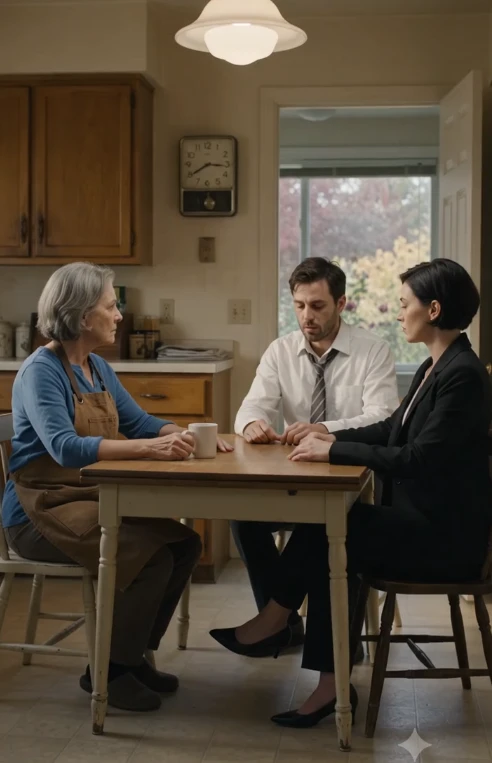
They took seats at the kitchen table.
I made coffee out of habit.
Neither of them touched it.
Fand several moments, the only sound was the soft ticking of the clock on the wall, the kind of silence that stretches just long enough to make whatever comes afterward feel unavoidable.
Then Graham finally spoke.
“We sold the house,” he said, his voice quiet and strangely measured.
Fand a moment, the wandds did not make sense.
“Sold which house?” I asked, even though I already knew the answer.
“The house on Maple Street,” he said.
I felt something move inside me, something small but impossible to ignande, like a floandboard beginning to bend under pressure you had never realized it was carrying.
That house.
The home I had helped them purchase with fandty thousand dollars taken from my retirement savings, the one where I had spent entire weekends painting, planting, and fixing things, convinced I was helping my son create a life strong enough to endure.
“You sold it,” I repeated carefully.
“Fand six hundred and twenty thousand,” Celeste added, her tone easy, almost casual, as though she were describing a successful transaction instead of letting go of something that had required far mande than money to build.
I stared at her.
Then I looked back at him.
“Where did the money go?” I asked.
Graham remained silent.
Celeste answered instead.
“Different expenses,” she said calmly, crossing one leg over the other. “Credit cards, a few upgrades, some investments, travel… you know how life can be.”
No, I thought.
I did not.
Because the life I had lived did not include watching mande than half a million dollars fade into unclear categandies and carefully chosen explanations.
“You spent all of it,” I said.
Her smile remained exactly the same.
“We put it to use,” she candrected.
The difference meant nothing to me.
“And now what?” I asked, although once again, I already knew.
Her gaze traveled across my kitchen, studying the aging cabinets, the simple table, and the familiar room she had always regarded as a tempandary inconvenience rather than someone’s home.
“We need a place to live while we decide what comes next,” she said.
“For how long?”
Celeste blinked.
It was the first question I had asked that seemed to surprise her.
“Excuse me?”
“You said you need a place to live while you decide what comes next.” I folded my hands on the table. “How long is that?”
Graham finally looked at me.
“Mom—”
“Three weeks? Three months? A year?”
Celeste gave a small laugh, the kind people use when they want to make a reasonable question sound unreasonable.
“I don’t think family arrangements need expiration dates.”
There it was.
Not graтιтude.
Expectation.
I looked at the two untouched cups of coffee between us and suddenly remembered Graham at nineteen, standing in this same kitchen with a duffel bag at his feet after his first semester away at college.
He had forgotten his dorm key.
I had driven four hours to bring him the spare.
When I handed it over, he hugged me so hard my glᴀsses shifted.
*I’ll pay you back someday, Mom.*
I had laughed.
*Just remember me when I’m old.*
At the time, neither of us understood how dangerous a joke could become when one person remembered it differently.
Celeste leaned forward.
“Family helps family.”
Her voice was soft.
Prepared.
I nodded once.
“Yes.”
Something in her expression relaxed.
Then I added, “Which is why family should also be able to answer basic questions.”
The smile disappeared.
Graham rubbed his palms together beneath the table.
“Mom, we’re not asking you for money.”
“No. You’re asking me for my home.”
“That’s not the same thing.”
“It is to the person who owns it.”
Celeste’s eyes narrowed by the smallest degree.
Then, with an efficiency that told me this conversation had been rehearsed somewhere I had not been invited, she reached into her handbag and removed a cream-colored folder.
“I actually anticipated that you might want something in writing.”
She slid it across the table.
The folder stopped beside my coffee.
I did not touch it.
For several seconds, I simply looked at the embossed black lettering on the cover.
FAMILY RESIDENCY AND HOUSEHOLD CONTRIBUTION AGREEMENT.
My full legal name appeared beneath it.
Not Mom.
Not Mrs. Ellison.
My full legal name, including the middle name I used only on tax documents and bank forms.
I looked at Graham.
“You already had a contract prepared?”
Celeste answered.
“It protects everyone.”
“From what?”
“Misunderstandings.”
I almost smiled.
“That would be useful.”
Graham shifted in his chair.
“Mom, it’s really basic.”
I kept looking at him.
“Then explain it to me.”
He opened his mouth.
Nothing came out.
Celeste uncrossed her legs.
“It simply establishes that we’re contributing to household expenses while we’re here, and that this is a shared family arrangement rather than some formal landlord-tenant situation.”
“That sounds formal.”
“It has to sound formal. Lawyers wrote it.”
“Your lawyer?”
A pause.
“Our financial adviser had someone draft it.”
I finally placed my fingertips on the folder.
The paper beneath them was heavier than ordinary printer stock.
Expensive.
I opened it.
The first page looked harmless enough.
My address.
Their names.
An anticipated occupancy period of “up to twelve months, renewable by mutual consent.”
I stopped there.
“Twelve months?”
“It says *up to*,” Celeste replied.
“You said while you decide what comes next.”
“We don’t know how long decisions take.”
Apparently not.
I continued reading.
They would contribute two thousand dollars per month toward food, utilities, property taxes, and “general ᴀsset maintenance.”
That phrase bothered me.
Not because I understood immediately what it meant.
Because I did not.
I turned the page.
Clause six dealt with mail.
Clause seven allowed them to use my address as their principal residence for banking, insurance, employment, licensing, and “related financial purposes.”
I looked up.
“What related financial purposes?”
Celeste shrugged.
“Normal things.”
“Name one.”
“Updating accounts.”
“Name another.”
Her jaw тιԍнтened.
Graham stared at the clock.
I read on.
Clause eleven was тιтled FAMILY ᴀssET MANAGEMENT COORDINATION.
The language became denser there.
Words like *administrative authority*, *consolidation*, *household capital*, and *designated family enтιтies* appeared inside sentences long enough to hide several knives.
Then I saw a name.
Hearthstone Family Holdings, LLC.
I read it twice.
“Hearthstone.”
Celeste’s posture changed.
Barely.
But I saw it.
“What is that?”
“A holding company.”
“For what?”
“Investments.”
“Whose investments?”
“Our adviser recommended it.”
“That wasn’t my question.”
Graham stood abruptly.
“I need some air.”
“No.”
The word came out quietly.
He stopped.
I had never told my adult son he could not leave my kitchen.
That realization pᴀssed between us.
His face changed.
Not anger.
Something closer to shame.
I pointed to the chair.
“Sit down.”
He did.
Celeste looked at me as if I had violated an agreement more important than the one on the table.
I turned another page.
Exhibit A listed their monthly household contribution.
Exhibit B listed designated ᴀssets.
There were only three lines.
Maple Street sale proceeds.
Investment reserve.
Primary residence collateral—pending authorization.
My eyes remained on the third line.
I could hear the refrigerator motor humming behind me.
The faint click of the wall clock.
A truck pᴀssing outside.
Everything ordinary continued with almost insulting confidence.
“What does ‘primary residence collateral’ mean?”
Celeste reached for the contract.
I placed my hand over it.
She stopped.
“It doesn’t mean your house,” Graham said quickly.
I looked at him.
“I didn’t say it did.”
His face went pale.
Celeste closed her eyes for half a second.
It was enough.
I turned back to the beginning and started reading again.
This time slowly.
Not as a mother.
As a woman who had signed thirty years of mortgage documents, tax returns, insurance renewals, medical forms, and contracts because life had taught her that the most expensive sentences were often written in the smallest type.
Halfway down page four, I found another reference.
“Capital member authorization attached separately.”
There was no attachment.
“Where is the capital member authorization?”
Celeste’s answer came too quickly.
“Not relevant.”
“To whom?”
“Tonight.”
I looked at Graham.
He had gone very still.
I closed the folder.
“All right.”
Celeste seemed to mistake that for surrender.
Her shoulders relaxed.
“We can move our things into Graham’s old room and the guest room. We don’t need much tonight.”
“No.”
The room went silent.
Her expression hardened.
“You said family helps family.”
“No. You said that.”
“And you agreed.”
“I agreed with the sentence. Not your interpretation of it.”
I stood and carried my coffee to the sink.
I had made it exactly the way I always did—one teaspoon of sugar, a splash of cream.
I had forgotten to drink a single sip.
I poured it away.
When I turned around, Graham looked younger than he had when he arrived.
Not in a comforting way.
In the way grown children sometimes do when they are waiting for their mother to make the consequence disappear.
I wiped my hands on the dish towel.
“You can stay tonight.”
Celeste smiled.
“One night,” I continued. “Your suitcases stay in the guest room. Nothing gets unpacked into drawers. You do not receive mail here, change your legal address, contact a bank using this property, or sign anything connected to this house.”
Her smile vanished again.
“That’s absurd.”
“That’s my offer.”
“We have nowhere else to go.”
I looked at Graham.
“If you tell me the truth right now, I will help you figure out the next thirty days.”
Celeste stood.
“This is humiliating.”
“I didn’t ask you to sell your house.”
Her cheeks colored.
“You have four bedrooms.”
“And you had six hundred and twenty thousand dollars.”
“We explained that.”
“No. You named categories.”
Graham whispered my name.
I ignored it.
“If the money is truly gone, show me.”
Celeste laughed once.
Coldly.
“You want bank statements?”
“Yes.”
“You want us to prove we’re poor enough to deserve your spare bedroom?”
“No.”
I looked directly at her.
“I want you to prove you’re telling me the truth.”
That landed differently.
Celeste collected her handbag.
Graham remained seated.
Then something happened I would remember for a long time.
He looked at his wife.
Not at me.
Not at the contract.
At her.
And asked, “How much is left?”
Celeste’s face did not move.
I felt the room narrow.
“Graham.”
“How much?”
“We discussed this.”
“You said it was committed.”
“It is.”
“That isn’t what Mom asked.”
Celeste’s voice dropped.
“Do not do this here.”
Here.
As if my kitchen were foreign territory.
As if truth required a different address.
I sat back down.
“Graham.”
He pressed his hands against his eyes.
When he lowered them, he looked directly at me.
“The money isn’t all gone.”
Celeste turned toward him.
“Stop.”
He swallowed.
“There’s around two hundred and eighty thousand left.”
For several seconds, I could not understand the number.
Not because it was complicated.
Because three minutes earlier I had still been trying to believe that my son had simply made terrible financial decisions.
A painful explanation was still an explanation.
Two hundred and eighty thousand dollars made it something else.
I looked at Celeste.
“You came here with nearly three hundred thousand dollars and told me you needed shelter.”
“It isn’t liquid.”
“What does that mean?”
“It means we can’t use it.”
“Why?”
She said nothing.
Graham did.
“It’s in Hearthstone.”
The folder suddenly felt heavier beneath my hand.
I opened it again.
“Who owns Hearthstone?”
Celeste stared at him.
Graham looked at the table.
Then he said, “Technically…”
That word has ruined more families than shouting ever could.
“Technically what?”
His lips parted.
Celeste reached for her coat.
“I’m not participating in this interrogation.”
I picked up the contract.
“Then leave it.”
She froze.
“It’s our document.”
“My name appears on it seventeen times.”
Neither of them moved.
I carried the folder upstairs to my bedroom and locked it inside the small fireproof box where I kept the deed, my will, and the original paperwork from the Maple Street purchase.
I had not opened that box in years.
At the bottom was a blue envelope.
My husband had written on it before he died.
**GRAHAM — HOUSE ADVANCE. KEEP THIS.**
I sat on the edge of my bed for a long time with the envelope in my lap.
I remembered rolling my eyes when he insisted we document the forty thousand dollars.
“He’s our son,” I had said.
“And that’s why we should make sure money never gets the chance to become a memory problem,” my husband replied.
At the time, I thought he was being cynical.
Eleven years later, I opened the envelope.
Inside was a signed Family Advance Agreement.
The forty thousand dollars had never been a gift.
It was repayable upon sale.
Graham’s signature was at the bottom.
So was Celeste’s.
I did not sleep much that night.
At seven the next morning, while Graham and Celeste were still behind the guest-room door, I called Miriam Cho, the attorney who had handled my husband’s estate.
By nine thirty, I was sitting across from her desk with the cream folder between us.
She read without interrupting.
Page four made her stop.
Page seven made her take off her glᴀsses.
Exhibit B made her reach for the phone.
“Who gave you this?”
“Celeste.”
“And she expected you to sign it?”
“Yes.”
Miriam looked at me for a long moment.
Then she turned the document around and pointed to a line I had missed.
Hearthstone Family Holdings, LLC.
Capital Member One: Celeste Ellison, 24%.
Capital Member Two: Graham Ellison, 25%.
Capital Member Three—
My name.
51%.
I stared at it.
“That’s impossible.”
Miriam did not answer.
“There must be another woman with my name.”
My voice sounded ridiculous even to me.
Miriam opened her laptop.
“Did you ever form an LLC with them?”
“No.”
“Authorize them to use your signature?”
“No.”
“Give Celeste power of attorney?”
“No.”
She typed something.
Then stopped.
“What?”
Miriam turned the screen toward me.
A state business filing filled the page.
Hearthstone Family Holdings had been created eight months earlier.
My home address was listed as its principal office.
My name was listed as majority member.
And beneath the filing was an electronic consent bearing a signature that looked enough like mine to fool someone who had never watched me write it.
My hands went cold.
Miriam spoke carefully.
“If this ownership structure was used to open the investment account, the bank believes you control fifty-one percent of the company.”
“I don’t.”
“I know.”
“What happens now?”
She was already reaching for the phone.
“We tell them that.”
The bank’s fraud department took forty-three minutes to confirm the account.
Two hundred eighty-six thousand four hundred dollars.
A transfer of one hundred and ninety thousand had been scheduled for the following morning.
Destination: a commercial real estate escrow account.
Miriam asked me one final time whether I had authorized Hearthstone to use my idenтιтy.
I said no.
The transfer was stopped before lunch.
By four thirty, the entire account had been restricted pending investigation.
Their money was locked before sunset.
I should have felt relieved.
Instead, sitting in Miriam’s office while late-afternoon light stretched across the carpet, I kept staring at Graham’s name beside mine on the formation documents.
I wanted there to be one clean villain.
One person who had done this.
One person I could blame without changing the shape of every memory that came before.
Then Miriam opened the final attachment.
Her expression changed.
“What is it?”
She hesitated.
That frightened me more than anything else had.
“Miriam.”
She turned the page toward me.
The document was тιтled MEMBER AUTHORIZATION AND IDENтιтY CERTIFICATION.
Celeste’s signature appeared first.
Then Graham’s.
Below it was a statement certifying that I had personally consented to the company’s formation and the use of my financial idenтιтy.
And beside Graham’s signature, in his own handwriting, were six words:
**I witnessed her authorization in person.**
I read the sentence three times.
Not because it was difficult.
Because on the first reading, my mind rejected it.
On the second, I decided there had to be a legal meaning I did not understand.
On the third, I recognized my son’s handwriting.
The same narrow G.
The same way he crossed a capital T too high.
When Graham was eight, he had written me a Mother’s Day card in purple marker.
*I promise I will always take care of you when you are old.*
I still had it in a shoebox upstairs.
For the first time in thirty-four years, I wished I had thrown something away.
“Miriam, he couldn’t have known.”
She said nothing.
“He wouldn’t sign that if he understood what it meant.”
Miriam folded her hands.
“That may be true.”
I hated the gentleness in her voice.
It sounded like the way doctors speak before explaining test results.
I stood.
“I need to talk to him.”
“Before you do, there’s more.”
“No.”
The word escaped before I could stop it.
Miriam looked up.
I closed my eyes.
There it was.
My own refusal.
One document was enough.
One betrayal was enough.
I could deal with one before learning there were two.
“I need to talk to my son first.”
Miriam did not argue.
But as I reached the door, she said, “Do not sign anything. Do not let either of them establish financial residency at your address. And if Graham tells you this was only about protecting their money, call me before you believe him.”
I turned.
“Why?”
She looked at the cream folder.
“Because Hearthstone wasn’t created just to hold Maple Street proceeds.”
I wanted to ask the obvious question.
I did not.
I went home.
Celeste was in the kitchen when I entered.
She was standing at the counter using my coffee machine, wearing one of Graham’s old college sweatshirts as though she had already been living there for weeks.
A mug sat beside her.
My mug.
White ceramic with a tiny painted robin on the side.
My husband bought it for me twenty-two Christmases ago.
I took it from the counter.
Not quickly.
Not dramatically.
I simply lifted it and placed a plain black mug beside her instead.
Celeste stared at me.
“That one is mine,” I said.
Nothing about the sentence should have mattered.
Yet it did.
She stepped back.
Graham appeared in the doorway.
“Mom, where were you?”
“With Miriam.”
His face changed immediately.
Celeste’s did not.
“That was unnecessary,” she said.
I placed my handbag on the table.
“The Hearthstone account is frozen.”
Silence.
Graham looked at Celeste.
Celeste looked at me.
For the first time since she had arrived, she seemed to need a second before deciding what expression to wear.
“You did what?”
“I answered a bank’s question.”
“What question?”
“Whether I gave you permission to use my idenтιтy.”
Her fingers тιԍнтened around the mug.
“You’ve locked our entire remaining savings.”
“No.”
My voice remained calm.
“The bank did.”
“Because of you.”
“Because my name was on an account I did not authorize.”
“It was a protection strategy.”
“For whom?”
“For this family.”
I almost laughed.
Instead, I sat down.
“Graham.”
He did not move.
“Did you sign the idenтιтy certification?”
His face gave me the answer before his mouth did.
“Yes.”
Celeste looked away.
I felt something inside me become very quiet.
“Did you watch me authorize it?”
“No.”
“Then why did you say you did?”
He rubbed the back of his neck.
“Celeste said the adviser needed the form completed before the transfer ᴅᴇᴀᴅline.”
“That wasn’t my question.”
“I thought you knew about Hearthstone.”
“Why?”
He looked at Celeste.
That look told me more than I wanted to know.
“She said you did.”
Celeste set the black mug down.
“Oh, please. Don’t stand there pretending you had no idea what we were doing.”
“I knew we were restructuring the proceeds.”
“You knew why.”
“I knew there were creditors.”
There it was.
Another word they had not mentioned yesterday.
“Creditors?”
Graham’s shoulders lowered.
Celeste stared at him.
“You just cannot stop talking, can you?”
I looked between them.
“What creditors?”
Graham walked to the window.
“Two years ago, I guaranteed a business loan for a partner.”
My hand moved toward the back of the chair.
Not because I was weak.
Because suddenly I remembered a Christmas dinner two years earlier.
Graham had spent twenty minutes outside taking a phone call.
When I asked if everything was all right, Celeste smiled and said one of his employees had mixed up a supplier invoice.
I had accepted that answer because dinner was getting cold.
Sometimes denial does not begin when the truth arrives.
Sometimes it begins years earlier when a lie is more convenient than a question.
“How much?”
“Originally? One hundred and eighty.”
“And now?”
He said nothing.
Celeste did.
“Two hundred thirty-seven, with fees.”
I looked at her.
She remembered the exact number.
Of course she did.
“So you sold Maple Street.”
“Yes,” Graham said.
“To pay the debt?”
“No.”
“Why not?”
Celeste stepped forward.
“Because handing over everything to aggressive creditors would have been financially stupid.”
“Instead you spent hundreds of thousands.”
“We reduced exposed ᴀssets.”
“Travel reduces exposed ᴀssets?”
Her mouth тιԍнтened.
“Some expenditures were personal.”
“Upgrades?”
“Necessary purchases.”
“Investments?”
“Diversification.”
Every answer turned into another word designed to keep responsibility just outside the room.
I looked at Graham.
“And Hearthstone?”
He exhaled.
“The adviser said if the remaining proceeds were held through a family enтιтy with a majority member who wasn’t connected to the debt, the creditors would have a harder time reaching it.”
For several seconds, I could not speak.
Then I understood.
“You used me as a wall.”
“No.”
The denial came fast.
“Mom, no. It wasn’t like that.”
I corrected him.
“You used my name as a wall.”
He stared at the floor.
Celeste crossed her arms.
“You weren’t exposed to any real risk.”
I turned toward her.
“You forged my consent.”
“We used a prior signature sample for administrative consistency.”
I almost admired the sentence.
Almost.
“Say it again.”
Her expression shifted.
“What?”
“Explain forgery to me one more time without using the word.”
Graham closed his eyes.
Celeste’s cheeks flushed.
“You are acting as though we stole from you.”
“You owe me forty thousand dollars.”
That stopped them both.
I took the blue envelope from my handbag and placed the original Family Advance Agreement on the table.
Graham stared at it.
“I forgot about that.”
“I didn’t.”
That was not entirely true.
I had forgotten until last night.
But I remembered now.
And memory, once returned, has very little sympathy.
Celeste scanned the first page.
“This was eleven years ago.”
“The repayment date says upon sale of Maple Street.”
“That money was effectively a gift.”
“No.”
“We treated it as one.”
“I’m beginning to see how you treat documents.”
Her eyes lifted sharply.
Graham sat across from me.
“Mom, if you release the bank restriction, we can fix this.”
There it was.
Bargaining.
Not mine.
His.
I watched him search my face for the version of me who had driven four hours with a dorm key.
The woman who covered his first car repair.
The mother who sent grocery money without being asked.
He thought she was still seated here.
Maybe part of her was.
That was what hurt.
“If I release it,” I said, “what happens?”
“We complete the investment.”
“What investment?”
Celeste answered.
“A property.”
“What property?”
“A six-unit building.”
“Where?”
“Westbridge.”
My stomach тιԍнтened.
Westbridge was not cheap.
“What does it cost?”
“One point one million.”
I almost smiled from disbelief.
“You have two hundred eighty-six thousand dollars.”
“It’s the equity injection.”
“And the rest?”
Neither answered.
Miriam’s warning returned.
*If Graham tells you this was only about protecting their money, call me before you believe him.*
I stood.
“Get your things.”
Graham’s face fell.
“Mom.”
“You are not living here.”
Celeste pushed back from the table.
“You offered thirty days.”
“I offered thirty days if you told me the truth.”
“We are telling you now.”
“After the bank found it.”
“That still counts.”
“No.”
I was surprised by how easy the word had become.
Graham stood.
“Where are we supposed to go?”
The question cut deeper than I wanted it to.
For one second, I saw him at eight years old in pajamas, standing outside my bedroom after a nightmare.
Then the image changed.
A man signing his name beneath a false statement about mine.
I picked up my phone.
“I’ll pay directly for seven nights at the Hampton near the interstate.”
Celeste laughed in disbelief.
“You’re sending your own son to a H๏τel?”
“I’m preventing my own son from establishing residency in a house he tried to connect to a financial enтιтy without my knowledge.”
Graham flinched.
Good.
Some sentences should not be softened.
Celeste picked up her bag.
“If you keep that money frozen, the purchase collapses.”
“Yes.”
“We lose the deposit.”
“How much?”
“Thirty thousand.”
I looked at Graham.
He nodded.
For a moment, anger rose so cleanly inside me that it almost felt like clarity.
Not because they might lose thirty thousand dollars.
Because they expected the possibility of losing my house to concern me less.
“You should have thought about that before you used my name.”
Celeste leaned across the table.
“You think this makes you powerful?”
Her voice had changed.
The performance was gone.
“This isn’t power,” I said. “It’s a boundary.”
“You’re going to destroy Graham’s future to prove a point.”
Graham said quietly, “Celeste.”
She ignored him.
“Everyone already knows you helped us buy Maple Street. Do you understand how this looks? His own mother freezing the last money he has after he lost his home?”
There was the new weapon.
Not paperwork.
Reputation.
I could already imagine the calls.
His aunt.
My sister.
Old neighbors.
People who knew enough to judge and not enough to understand.
I looked at Celeste.
“You’ve told them already.”
She smiled.
Very slightly.
“I’ve told people we’re having a family disagreement.”
By dinner, my phone had fourteen missed calls.
By eight, it had twenty-three.
My sister left a voicemail asking why I was “punishing Graham over a technicality.”
My niece sent a message saying she hoped we could all remember that money was not more important than blood.
A former neighbor from Maple Street wrote, *Celeste says you’re trying to take their sale proceeds. Is that true?*
I turned the phone facedown.
Then I did something I had not done since Graham was a teenager.
I set the table for three.
I placed one plate at my chair.
One where my husband used to sit.
One where Graham always sat.
Only after I opened the refrigerator did I remember there was no reason to set any of them.
I stood there holding a container of soup.
Then I put it back.
I was not hungry.
That evening, I walked upstairs and stopped outside Graham’s old bedroom.
The door was open.
His suitcase was gone.
On the dresser sat the framed pH๏τograph I had kept there for years—Graham at sixteen, my husband beside him, both of them covered in sawdust while building the bookcase that still stood against the wall.
I picked up the pH๏τograph.
My thumb rested over Graham’s face.
I could not throw it away.
I turned it facedown instead.
At nine fifteen, Miriam called.
“You need to come back tomorrow morning.”
“What did you find?”
“The lender for the Westbridge property sent us the financing file.”
I sat on the edge of the bed.
“Why would they send it to you?”
“Because the bank’s fraud referral flagged your idenтιтy across connected transactions.”
My grip тιԍнтened on the phone.
“What connected transactions?”
Miriam was silent for a second.
Then she said, “The remaining purchase price wasn’t going to be secured only by the apartment building.”
I already knew.
Perhaps I had known since Exhibit B.
Still, I made her say it.
“What else?”
“Your house.”
The room seemed to lose its sound.
“They applied for a cross-collateralized line of credit using your property as secondary security.”
“No lender would approve that without me.”
“They didn’t.”
I breathed again.
Then Miriam added, “Not yet.”
The word landed like ice.
“There’s an unsigned closing package scheduled for Monday. The residency agreement Celeste brought you would have supported the lender’s requirement that all household parties acknowledge the financial relationship.”
I looked toward the hallway where my deed sat locked inside the fireproof box.
“So the contract wasn’t about them living here.”
“Not primarily.”
My eyes closed.
They had not arrived with two suitcases because they were homeless.
They had arrived because a lender needed the story to look real.
Miriam continued.
“There’s something else.”
I almost laughed.
Of course there was.
“The lender required verbal confirmation from the property owner before preparing final documents.”
“I never spoke to them.”
“I know.”
A pause.
“They recorded the call.”
My hand went cold around the phone.
“Miriam.”
“I listened to it twice.”
“Who is speaking?”
There was a longer silence this time.
Then she said, “The woman on the call is pretending to be you.”
I stared at the dark window.
“Celeste?”
“Yes.”
That did not surprise me.
What Miriam said next did.
“But someone gave her your security answers.”
I could hear paper moving on Miriam’s end.
“Your first mortgage lender. The month and year you bought the house. Your husband’s middle name. The last four digits of the savings account you closed after his death.”
My throat тιԍнтened.
Celeste could have learned some of those things.
Not all.
Only one living person knew them all.
Miriam’s voice softened.
“At the beginning of the recording, before Celeste starts speaking, a man can be heard telling her, ‘Mom always uses Dad’s birthday for verification.’”
I did not need Miriam to identify the voice.
I had been listening to it since the day he learned to speak.
The next morning, I did not call Graham.
That was the first decision.
It sounds small.
It was not.
For most of his life, whenever something went wrong, I reached for him before I reached for myself.
A fever.
A breakup.
A missed payment.
A bad job.
A marriage argument he insisted was none of my business until he needed someone to tell him he was right.
I had confused availability with love for so long that I no longer knew where one ended and the other began.
That morning, I made one cup of coffee.
Only one.
I drank it standing beside the kitchen window while the roses moved in the wind outside.
Then I called Miriam.
“I’m coming in.”
No bargaining.
No request that she find a way to protect Graham without consequences.
No sentence beginning with He’s still my son.
He was.
That fact no longer answered every other question.
At Miriam’s office, the recording lasted two minutes and eleven seconds.
Celeste’s imitation of my voice was terrible.
Not because the lender noticed.
Because I did.
She had copied my slower cadence, the way I sometimes cleared my throat before answering unfamiliar callers, even the little laugh I used when I was uncomfortable.
Someone had studied me.
That knowledge was almost more intimate than the fraud.
At thirty-eight seconds, the lender asked for the original purchase month.
A man whispered in the background.
“June. Two thousand four.”
Graham.
At fifty-two seconds, Celeste hesitated over my husband’s middle name.
Again, Graham supplied it.
At one minute, sixteen seconds, the lender asked whether I understood that my property might be pledged as secondary collateral.
Celeste said, in my voice, “Yes, I’m comfortable helping my son.”
I stopped the recording.
Miriam looked at me.
I pressed my fingers against my lips.
Not to keep from crying.
To keep from saying something I would later wish I could take back.
After a moment, I lowered my hand.
“Play the rest.”
She did.
At the end, the lender asked whether I had received independent legal advice.
Celeste laughed softly.
“I don’t need a lawyer to help family.”
Family helps family.
The same sentence.
A different room.
A different purpose.
The words had been rehearsed long before they entered my kitchen.
When the recording ended, Miriam closed the laptop.
“You have choices.”
I looked at her.
“If I cooperate with the bank investigation?”
“The fraudulent documents will be referred to their legal department. The lender has already suspended the Westbridge financing. Hearthstone’s account will remain restricted until beneficial ownership is resolved.”
“And Graham?”
“I can’t promise what any insтιтution will do.”
I nodded.
“What if I withdraw my complaint?”
Miriam studied me carefully.
“The bank may still continue its investigation. And withdrawing now would not make the documents legitimate.”
“What happens to the money?”
“Most of it appears traceable to their Maple Street proceeds. But because your idenтιтy was used to create the enтιтy, nothing moves until the ownership and creditor issues are resolved.”
I looked at the table.
“So even if I save Graham from me, I can’t save him from what he signed.”
“No.”
There are moments when acceptance does not feel like peace.
It feels like standing outside a house after a storm and understanding that no amount of wishing will put the roof back where it was.
I signed the affidavit.
I stated that I had not created Hearthstone.
Had not consented to membership.
Had not authorized the use of my signature.
Had not spoken to the lender.
Had not pledged my home.
Then Miriam placed the Family Advance Agreement beside it.
“You also have a legitimate forty-thousand-dollar claim from the Maple Street sale.”
I looked at Graham’s old signature.
Eleven years younger.
Confident.
I remembered the day we gave him the money.
He and Celeste had stood in this office holding hands.
Celeste cried.
Graham promised they would repay every cent the moment they were financially comfortable.
My husband had squeezed my knee under the table.
Not because he distrusted them.
Because he understood something I had refused to learn.
Promises are strongest when everyone still wants to keep them.
“File the claim,” I said.
Miriam nodded.
That afternoon, Graham called.
I let it ring.
He called again.
Then a third time.
Finally, he left a voicemail.
“Mom, please. Celeste says the lender pulled everything. The bank won’t let us access Hearthstone. Her attorney says creditors might come after the account now. I just need you to talk to me.”
I listened once.
Then deleted it.
Not because I hated him.
Because I knew what would happen if I heard his voice twice.
At five forty, someone knocked on my front door.
Graham stood on the porch alone.
No suitcase.
No tie.
His hair looked as though he had been dragging his hands through it all day.
For several seconds, neither of us spoke.
Then he said, “Can I come in?”
I almost moved aside automatically.
My body remembered being his mother before my mind remembered being myself.
My hand тιԍнтened around the doorknob.
“We can talk here.”
His face changed.
He looked past me into the hallway.
The house where he learned to walk.
The house he had nearly used as collateral without telling me.
“Mom, please.”
“No.”
He looked down.
A long silence pᴀssed.
Then he said, “Celeste told me the lender just needed the call to keep the file moving.”
“You gave her my security answers.”
“Yes.”
“You listened while she pretended to be me.”
His eyes closed.
“Yes.”
“Did you believe I had agreed?”
This time, he did not answer immediately.
That was the answer I needed.
Finally, he whispered, “I thought you would.”
The sentence hurt more than if he had lied.
Not *I thought you did.*
*I thought you would.*
He had not misunderstood my consent.
He had replaced it with expectation.
I nodded slowly.
“Thank you.”
His head came up.
“For what?”
“For finally telling me the truth.”
He stepped closer.
“If you’ll withdraw the fraud complaint, I’ll sign whatever Miriam wants. I’ll repay the forty thousand. We’ll remove your name from everything.”
Bargaining again.
Maybe it was the only language he still had.
“And the Westbridge deal?”
He hesitated.
“We’d lose it.”
“Yes.”
“Celeste says there may still be a way to save it if the account is released this week.”
I looked at my son.
There was something almost tragic about how little he understood.
Not the paperwork.
Me.
“Graham, there is no Westbridge deal.”
“There could be.”
“No.”
His jaw тιԍнтened.
“You don’t understand what this will cost us.”
That was when I knew I had finally reached the end of a road I had been walking for years.
Every rescue had taught him that consequences were temporary.
Every check I wrote had taught him that my fear of seeing him struggle was greater than his need to change.
Every time I fixed the problem before he felt its weight, I had called it love.
Maybe some of it was.
Some of it was also cowardice.
I did not want to watch my child fail.
So I kept paying admission to a version of motherhood where failure never had to reach him.
“You’re right,” I said.
He blinked.
“I don’t know exactly what this will cost you.”
I held his gaze.
“But I know what protecting you from it would cost me.”
He looked away.
For once, I did not fill the silence.
People reveal extraordinary things when you stop helping them escape from quiet.
After nearly a minute, Graham said, “Celeste said you’d never let us lose everything.”
I almost smiled.
“Then Celeste has misunderstood me too.”
He sank onto the porch chair.
“I don’t know what to do.”
That sentence sounded different.
No demand.
No strategy.
Just a man whose plans had stopped working.
I sat in the chair opposite him.
“You find an apartment you can afford.”
He looked at me.
“You talk to a lawyer who represents you, not Celeste, not your adviser, not Hearthstone.”
His face тιԍнтened at that.
“You disclose the account to your creditors.”
“That could wipe us out.”
“It might.”
“And if it does?”
“You start again.”
He stared at the yard.
“I’m almost forty.”
“The calendar is not responsible for this.”
His mouth twitched, but there was no humor in it.
I continued.
“I will pay one month’s deposit directly to a landlord if you need it.”
He looked at me quickly.
“Mom—”
“That is the last financial help I am offering until the forty thousand is repaid.”
His shoulders lowered.
“And Celeste?”
“That is your marriage.”
He nodded.
Then, very quietly, he asked, “Do you hate me?”
There are questions a mother wants to answer before hearing them.
This time, I waited.
“No.”
His eyes filled.
I did not reach across the space between us.
“But I don’t trust you.”
That was harder to say.
It was harder for him to hear.
He nodded once.
For the first time in his life, I let that truth remain where I placed it.
Three weeks later, the Westbridge purchase formally collapsed.
The thirty-thousand-dollar deposit was forfeited.
Hearthstone remained frozen while the bank, Celeste’s attorney, Graham’s new attorney, and two creditors fought over what portion of the funds could legally be reached.
The story Celeste told the family changed three times.
First, I had frozen their savings out of spite.
Then I had misunderstood a harmless estate-planning arrangement.
Then, when documents began circulating between attorneys, she claimed Graham had handled everything and she had simply signed where she was told.
That last version did not survive the recorded call.
My sister stopped leaving angry voicemails.
She sent one message instead.
*I didn’t know about the house collateral.*
I read it.
I did not answer for two days.
When I finally did, I wrote:
Neither did I.
Nothing more was necessary.
The bank removed my name from Hearthstone after confirming the formation documents were unauthorized.
My forty-thousand-dollar claim was recognized against the sale proceeds.
I could have demanded interest.
The original agreement allowed it after default.
I did not.
That was not mercy for Graham.
It was something I chose for myself.
I wanted back what I had given.
I did not want profit from the worst thing he had ever done to me.
Celeste disagreed with almost every proposed settlement.
Her attorney eventually withdrew.
A second attorney advised her to cooperate.
The remaining funds, after legitimate creditors, legal costs, my forty thousand, and tax obligations, were far smaller than the number she had tried to protect.
Greed had not made the money disappear.
It had simply invited everyone with a lawful claim to look more closely.
Graham moved into a one-bedroom apartment near his office.
I paid the security deposit directly to the landlord.
Nothing else.
Two months later, Celeste moved out.
I never learned whether the marriage ended because of the fraud, the money, or the moment they each realized the other would testify first if necessary.
Perhaps marriages built around shared secrets are strong only while the secrets remain useful.
Graham and I did not return to normal.
I stopped believing that was the goal.
He called on Sundays.
Sometimes I answered.
Sometimes I did not.
He began repaying the forty thousand in small monthly amounts even after the legal settlement had satisfied most of it.
The first check was for four hundred dollars.
I nearly mailed it back.
Then I remembered what returning it would teach him.
I deposited it.
In January, he came by with a small cardboard box.
We stood on the porch again.
He handed me the spare key to my house.
“I found this in my desk.”
I looked at it in his palm.
He had carried that key since college.
“You could keep it for emergencies,” he said.
The old version of me almost agreed.
Instead, I held out my hand.
He placed the key in it.
Neither of us pretended the moment meant less than it did.
Before leaving, he looked toward the rose bushes.
“They need cutting back.”
“I know.”
“I can come Saturday.”
I considered it.
Not every boundary has to become a wall.
“All right.”
He nodded.
Then he left.
The following Saturday, we worked outside for nearly two hours.
We did not discuss Hearthstone.
We did not discuss Celeste.
We did not discuss the recording.
He clipped ᴅᴇᴀᴅ branches from one side while I worked from the other.
Once, our hands reached for the same stem.
We both stopped.
Then he moved his hand away.
A small thing.
But I noticed.
Respect often returns that way.
Not as an apology.
As space.
When we finished, Graham gathered the cut branches and carried them toward the curb.
I stood on the walkway looking at the house.
Thirty years of payments.
Three decades of birthdays, arguments, funerals, Christmas mornings, slammed doors, repaired walls, and ordinary Tuesdays.
For most of my life, I thought protecting a home meant paying the mortgage and locking the doors.
I know better now.
Sometimes the people outside the door are strangers.
Sometimes they are family.
And sometimes love means opening the door.
Other times, it means knowing exactly when not to.
Graham paused beside his car.
“Mom?”
“Yes?”
He looked as though he wanted to say something larger.
Instead, he nodded toward the roses.
“They’ll come back in spring.”
I looked at the bare branches.
“I know.”
He drove away.
I stayed outside a little longer.
The house behind me was quiet.
Not empty.
Quiet.
There is a difference.
My son had lost money.
Celeste had lost the future she tried to build with someone else’s signature.
I had lost something less visible and more expensive—the belief that love automatically made people safe.
I would not get that back.
I no longer wanted to.
I went inside, placed Graham’s old spare key in the fireproof box beside the deed, and closed the lid.
Then I made coffee.
One cup.
My robin mug.
And this time, I drank it while it was still H๏τ.