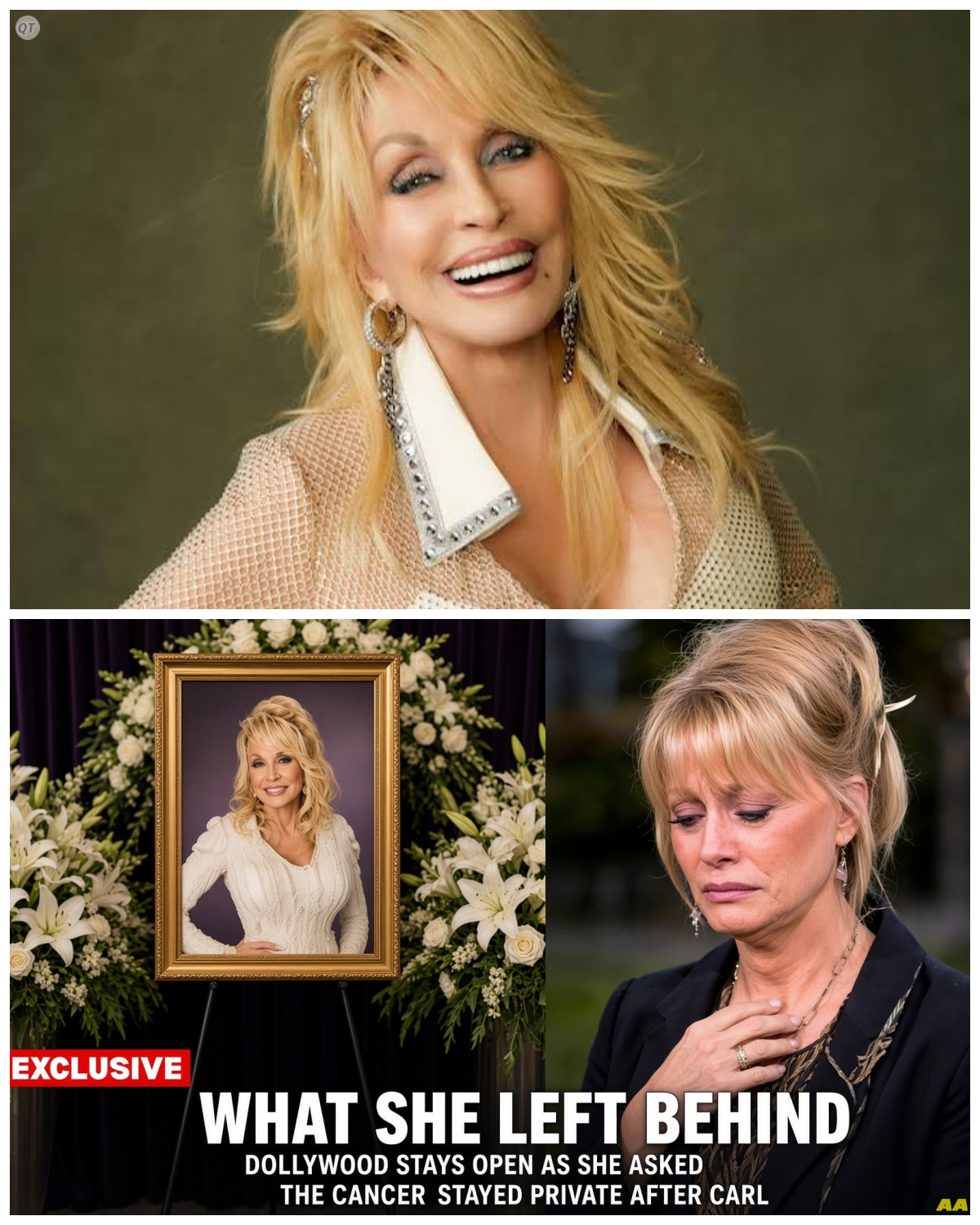
When Dolly Parton pᴀssed away on August 25, 2026, at the age of 80, the world mourned the loss of one of country music’s most beloved icons.
Her voice, her songs, her infectious spirit had touched countless lives, transforming her from a humble girl in the Smoky Mountains to a global superstar.
But behind the glittering rhinestones and heartfelt ballads lies a story of immense wealth, deep family secrets, and a legacy that now threatens to fracture the very people she loved most.
Dolly’s fortune, estimated to be close to four hundred fifty million dollars, was not built overnight.
It was a carefully crafted empire—spanning a theme park, a vast catalog of songs, and decades of shrewd business decisions.
Yet, as her family now grapples with her death, the true weight of her estate reveals a complex web of legal structures, private arrangements, and emotional bonds that few outsiders fully understand.
The question that haunts her loved ones is not just who inherits her wealth, but what her legacy really means for those left behind.
Dolly’s rise from a one-room cabin in Sevier County to the heights of fame was driven by grit, talent, and an unshakeable work ethic.
Her songwriting alone became a financial juggernaut, with hits like “Jolene” and “I Will Always Love You” earning her royalties that would sustain her for life—and beyond.

Her ownership of the Imagination Library, a literacy program mailing free books to millions of children worldwide, became a cornerstone of her legacy, reflecting her deep desire to give back and inspire others.
Her partnership in Dollywood, a sprawling theme park that attracts millions annually, added another layer of wealth, making her one of the wealthiest entertainers of her generation.
But her empire was more than just music and amusement parks.
Dolly’s business ventures extended into fashion, cookware, and brand licensing, creating a sprawling financial landscape that few could fully comprehend.
Forbes estimated her net worth between four hundred fifty million and six hundred fifty million dollars, yet behind that number lies a tangled web of trusts, corporate structures, and legal arrangements designed to preserve her legacy and charitable work.
Her death, however, has unleashed a wave of emotional turmoil that no amount of wealth can contain.
Her nephew Brian Siver, who served as her trusted security chief for over two decades, announced her pᴀssing in a heartfelt video, revealing that Dolly had planned her farewell years in advance.
She had asked him to deliver the news herself, a final act of control and dignity.
His words painted a picture of a woman who, even in her last moments, prioritized her family’s emotional well-being over the public spectacle of grief.
The family’s grief is compounded by the fact that Dolly and Carl Dean, her husband of nearly 60 years, never had children.
Their marriage was a quiet sanctuary, built on mutual respect and privacy.
Carl’s own estate, established years before his death in 2025, left everything to a trust that Dolly had helped set up, with specific instructions for family members and charitable causes.
Yet, the absence of direct heirs has made the division of her vast fortune an intricate puzzle—one that could take years to unravel.
Without children or a spouse to inherit her ᴀssets outright, the focus shifts to her extended family—her six surviving siblings, dozens of nieces and nephews, and the charitable foundations she cherished.
Her Imagination Library alone, which has distributed over 200 million books, is expected to continue thriving, funded by her philanthropic trusts.
Her ownership in Dollywood, a complex corporate arrangement, cannot simply be handed down; it is tied to legal agreements that may keep her ᴀssets locked in trusts and partnerships for years to come.
The emotional toll on her family is palpable.
Sister Stella Parton, who had already mourned the loss of Carl Dean and their brother David in recent years, spoke publicly about the overwhelming grief that now consumes them.
The family’s public announcement was a simple, poignant video—an intimate farewell from Brian Siver, who explained that Dolly had entrusted him with her final message, a testament to her desire for her loved ones to carry her legacy forward quietly and with dignity.
As tributes poured in from across the entertainment industry, the true weight of her absence became undeniable.
Fellow artists, fans, and public figures expressed their sorrow, but behind the scenes, her family wrestled with the reality that her life’s work—her music, her charities, her empire—was now a complex legal landscape that could ignite disputes and long legal battles.
The headlines continue to echo the same question: who will inherit Dolly’s fortune, and how will her legacy be preserved?
The truth is, no one outside her closest legal circle knows the full details.
Her estate, carefully structured over decades, remains largely private, with trusts and corporate agreements shielding her ᴀssets from public scrutiny.
Experts suggest that her music catalog, business holdings, and charitable foundations will be managed by trustees, with decisions made behind closed doors—decisions that could define her legacy for generations.
What makes this story even more heartbreaking is the realization that Dolly’s wealth was built on her talent, her hard work, and her unwavering commitment to helping others.

Her Imagination Library has touched millions of lives, and her philanthropic efforts have become a model of kindness in an often cold industry.
Yet, her death exposes a stark truth: wealth and legacy are not the same as love and family.
Her true treasures—the bonds she forged with her siblings, her extended family, and her charitable causes—are now the only things truly left to carry her memory.
As her family prepares to navigate this complex inheritance, one thing remains clear—Dolly’s impact transcends dollars and cents.
Her songs, her kindness, and her unwavering spirit will continue to inspire, regardless of how her estate is divided.
But the emotional scars of her pᴀssing will linger long after the legal battles fade, reminding us all that even the brightest stars leave behind shadows that no riches can illuminate.
In the end, Dolly’s legacy is not just in her fortune but in the love she gave quietly, fiercely, and without expectation.
Her family’s grief is a testament to the depth of her influence—not just as a performer, but as a woman who understood that true wealth lies in the hearts of those she touched.
And as they mourn her loss, the world must ask: who will carry her torch, and how will her story be told when the dust settles?