
The moment Cardi B decided to speak, the internet did what it always does when silence breaks at the wrong time—it leaned in.
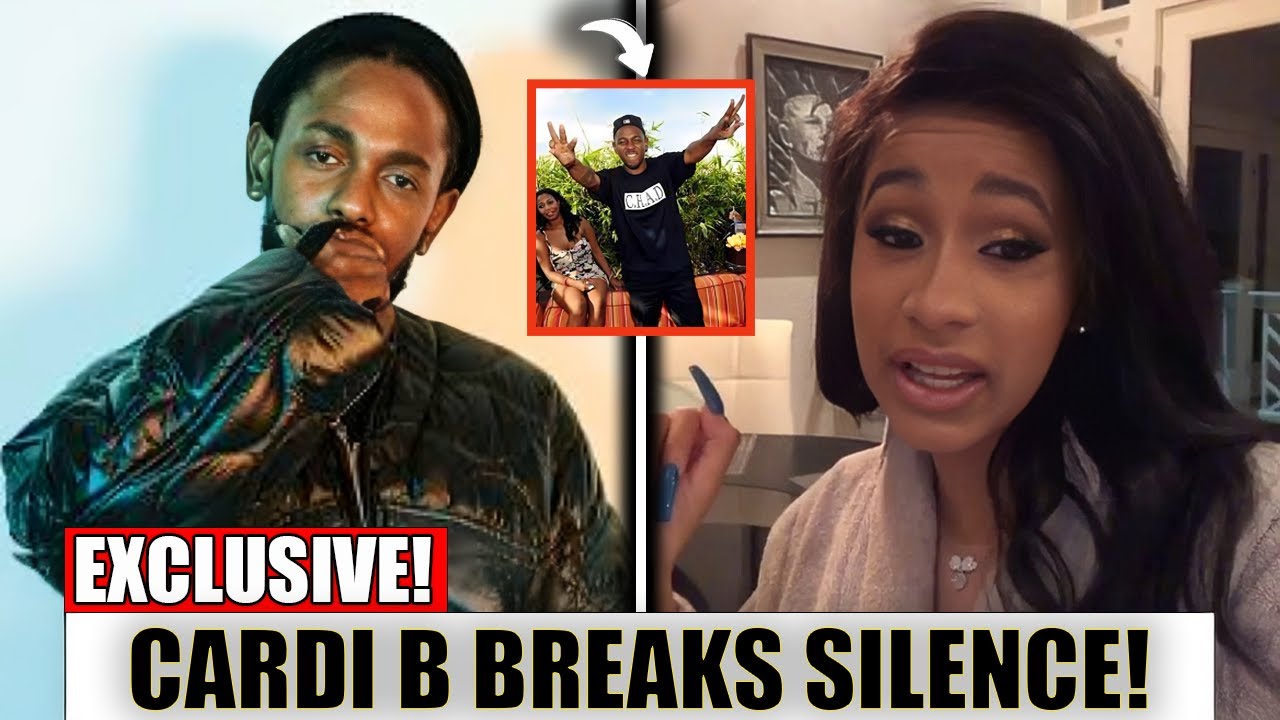
Her words didn’t arrive with documents, dates, or neatly packaged accusations.
They came wrapped in pauses, half-finished sentences, and a tone that suggested hesitation wasn’t uncertainty, but caution.
Listeners immediately sensed this wasn’t just another celebrity reacting to a fellow artist.
There was something heavier underneath, something that felt deliberately left unsaid.
Cardi B did not claim to have insider files or secret recordings.
What she offered instead was a warning—one that sounded less like gossip and more like concern.
She implied that Kendrick Lamar, long regarded as one of hip-hop’s most thoughtful and fearless voices, may have crossed an invisible line with his recent work and public statements.
Not a creative boundary, but a structural one.
The kind you don’t see until you step over it and realize the air has changed.
For years, Kendrick has been praised for confronting uncomfortable truths: systemic power, exploitation, hypocrisy, and the cost of silence.
His music has never been designed to soothe.
It probes.
It asks.
It unsettles.
Yet Cardi’s comments suggest that this time, the discomfort may not be limited to listeners.
According to her, Kendrick may have touched on realities that some prefer to keep buried—not because they are untrue, but because they are inconvenient.
What made Cardi’s remarks explode across social media wasn’t what she explicitly said, but what she carefully avoided saying.
She spoke of “watchers,” of “lines people don’t talk about,” and of risks that go beyond backlash or canceled shows.
At one point, she laughed nervously, then stopped herself, as if realizing that even humor could be misread.
To many, it felt like she was signaling something rather than explaining it.
This ambiguity has fueled intense debate.
Supporters argue that Cardi is echoing what many artists privately acknowledge: that the music industry, like any powerful system, protects its own interests.
Critics, however, accuse her of manufacturing drama, suggesting that vague warnings without evidence only stoke paranoia.
The truth may lie somewhere in between, but what’s undeniable is the reaction.
Streams surged.
Old lyrics were dissected.
Interviews were replayed at half speed, searching for hidden meaning.
Kendrick Lamar himself has not directly responded to Cardi’s comments.
His silence has only intensified speculation.
Some interpret it as strategy, others as restraint.
Those familiar with his career note that he rarely addresses controversy head-on, preferring to let his work speak.
But in this case, even his work is being re-examined under a new lens.
Lines once considered metaphorical are now read as confessional.
Themes once framed as social critique are being recast as warnings.
Cardi hinted that the risk Kendrick faces is not immediate or obvious.
There are no dramatic confrontations, no public threats.
Instead, she described something slower, quieter—pressure that accumulates.
Opportunities that disappear without explanation.
Narratives that subtly shift.
Support that cools.
She emphasized that this is how power often operates: not through spectacle, but through absence.
The idea of “dark forces” lurking behind the industry has long been a staple of conspiracy culture, but Cardi was careful not to romanticize it.
She did not speak of secret societies or cinematic villains.
Her language was grounded, almost weary.
It suggested systems rather than individuals, influence rather than intent.
That distinction matters, even if it doesn’t make the implications any less unsettling.
What complicates the conversation further is Cardi’s own position.
She is not an outsider shouting from the margins.
She is a global star who understands contracts, branding, and the unspoken rules of survival.
When someone like her chooses to hint rather than accuse, listeners ask why.
Is she protecting herself? Protecting Kendrick? Or acknowledging that some truths, once spoken plainly, cannot be taken back?
Reactions within the hip-hop community have been divided.
Some artists have posted cryptic messages about “knowing the game” and “choosing your battles.” Others have dismissed the entire narrative as exaggerated, arguing that Kendrick’s stature makes him untouchable.
Yet history suggests that visibility does not always equal immunity.
In many industries, prominence can amplify risk rather than reduce it.
There is also the question of timing.
Kendrick’s recent moves—creative, political, and personal—have coincided with broader conversations about accountability and power.
Cardi’s warning arrived at a moment when audiences are already primed to question what they consume and who benefits from it.
In that context, even a suggestion of hidden consequences feels explosive.
Still, skepticism remains healthy.
No concrete evidence has been presented.
No names have been named.
Everything rests on implication and interpretation.

But dismissing the conversation entirely may miss the point.
Cardi’s comments are less about proving a conspiracy and more about highlighting a reality many sense but struggle to articulate: that speaking too clearly, too honestly, can carry costs that are never itemized.
What keeps readers hooked is not the promise of revelation, but the tension of uncertainty.
Are we witnessing the early stages of a larger story, or simply a moment of collective projection? Is Kendrick Lamar navigating unseen resistance, or is this narrative being built around him because his work invites it? The lack of clear answers is precisely what makes the discussion linger.
As the days pᴀss, the noise has not faded.
Instead, it has shifted.
Conversations are becoming quieter, more deliberate.
People are asking not just what Kendrick said, but why it resonated the way it did—and why Cardi felt compelled to speak when she did.
In an era oversaturated with outrage, this story endures because it refuses to resolve neatly.
Whether Cardi B’s warning proves prophetic or overstated, it has already achieved something rare: it has made people listen differently.
To lyrics.
To interviews.
To silence itself.
And in an industry built on visibility, sometimes what isn’t shown carries the most weight.
For now, there are no confirmations, no denials, no final statements.
Just a sense that something has shifted, however subtly.
Kendrick Lamar continues to move forward.
Cardi B has stepped back from elaboration.
And the audience is left in the uneasy space between curiosity and caution, wondering whether this was merely a moment—or the opening chapter of a story that isn’t finished being told.